Sunday, February 23, 2014

West of Wells - Holkham, Sculthorpe and Titchwell

It is easy to get to Holkham from Wells by foot. The tide was coming in so a check of the beach was a priority. There had not been any reports of either snow buntings nor shore larks so scanning the sea seemed to be the best option. It was quiet most of the time there but I did see a single diver fairly close in. The dark half collar and almost black head demonstrated it to be a Great Northern Diver. It only stayed for about five minutes so I headed back inland to view the fields immediately south of the trees. Hundreds of wigeon, lapwing, a few pinkfeet, more teal, a few Egyptian geese and in a nearby pool a pair of goldeneyes. I was also able to observe the long staying Rough-legged Buzzard.
 
A trip to Sculthorpe Moor Nature reserve has also become a must for me. Two years ago I was able to photograph a Golden Pheasant there. Sadly this bird is no longer present. There were several marsh tits, nuthatch, long tailed tits, a very obliging water rail, a red kite and I don't think I have seen so many bramblings. The woodland also contained siskins, lesser redpolls and a drumming great spotted woodpecker


Titchwell is not too far from here either. Throughout the week I was able to see the damage that the tidal surge had left from December. At Titchwell the damage to the dunes was very evident. A brisk walk to the shore for a short time of sea watching revealed great crested grebes, thousands of common scoters, more dunlin, sanderling, turnstone, oystercatchers, curlews and a spotted redshank on the way there. Returning to the hides a very close grey plover gave excellent views, while on the fresh water its cousins, the golden plover were less obliging. I had good sightings of avocets, pintail, snipe, little egret, more Brent geese, and an elusive Mediterranean Gull. There was a woodcock sitting close to the entrance path in the small area of woodland. It was a brilliant demonstration of this bird's camouflage application. Even though we knew the location, we still had problems seeing it.


The journey home was brightened by an appearance of a barn owl sitting quietly on a fence post.


North Norfolk - Wells to Strumpshaw


I last visited Norfolk to celebrate becoming 70. In December last year, when I saw an offer to stay at a YHA hostel at a reduced rate for members I took it. Wells is ideally situated in the centre of the north Norfolk coast and by travelling by train, then using a senior citizens bus pass, both my bank balance and carbon footprint are helped. Despite the rest of the country experiencing constant rain, the week I stayed here was comparatively dry. An initial walk from the harbour to the RNLI house is always a good start. The plaintive cries of redshanks compete with the slightly louder oystercatchers as I commenced the journey. Skylarks were singing overhead and on hearing the distinctive sound of Brent geese, I knew I was on the East coast. I repeated this walk a number of times during the week and managed to note ringed plover, bar tailed godwit, little egret, little grebe, curlew, dunlin, sanderling and the usual plethora of gulls. Using my telescope to scan the sea helped me to spot several seals and a pair of Red Breasted Mergansers. Most evenings, I heard a tawny owl in the car park, and several mornings a song thrush was my early alarm clock.


I did rent a car for one day to visit Strumpshaw Fen. I always enjoy visiting there but must try some time in summer to see the Swallowtail butterfly. Marsh Harriers were quite active and an otter made a brief appearance. Sadly too brief to obtain a photo. A distant smew also made a record shot impossible. The sunshine did enable me to see teal, shoveler, mute swans, marsh tits, nuthatch, great spotted woodpecker plus the more common woodland birds. There was even some white dead nettle in flower. The photos also confirm that rare occurrence.. sunshine. 


Sunday, January 12, 2014

A Week of Volunteering

At the start of the year, I thought I'd give a taster of the first full week of my New Year

Monday:
Go to Cuerden Valley Park (CVP) for staff meeting. Short walk round the lake for a survey of birds. There were a few long tailed tits, a sparrowhawk, 12 goosanders, some siskins, a treecreeper and 7 mallards. Bird feeders were then filled and sightings entered to database.
Home for lunch and started a free on-line course from FutureLearn on "Sustainability". This one is delivered by Nottingham University
In the evening I went to listen to an excellent talk by John Poland on " Rare Plants in Britain" There were only two of these that I have seen; Lady's Slipper Orchid and Yellow Whitlowgrass. It also gave me the opportunity to ask David Earle, BSBI recorder for vc59 South Lancs, about botanical records in Chorley. 

Tuesday:
Another visit to CVP where the Park manager took me to an area where he showed me a few elm tree. Last summer we had a sighting of 16 White Letter Hairstreak butterflies and I wanted to search for the eggs. Jan/Feb is the best time, but not today as I had another appointment. The regular Health Walk, normally held each Thursday was having an extra day on a Tuesday to see whether there was any support. I helped lead this, which lasts for about an hour. As you can see from the picture, they were not put off by the rain. I of course also point out any wildlife interest. We had more goosanders, Canada geese, great crested grebe, nuthatch, a tree-creeper, grey wagtail and we saw butterbur starting to emerge near the wooden footbridge. This was completed by lunch so the afternoon was another time to spend on the Sustainability course.

Wednesday:
In the morning I went to Lancashire Wildlife Trust's Brockholes reserve to lead a walk for the Preston U3A Birdwatching group. There were about a dozen of us. A couple of buzzards circled above as the group were gathering and we were disappointed that a great white egret had flown away just fifteen minutes earlier. We had an hour and a half looking at both Meadow Lake and also the romantically named No1 Pit. Grey Heron, Mute swans, tufted ducks, mallard, shoveler, cormorant and the ubiquitous coot were noted at the first area. Viewing over the second lake we added snipe, great crested grebe, gadwall, goldeneye, several gulls and moorhen. In the hedgrow nearby we saw chaffinches, robins, great and blue tits, blackbird, two very confiding meadow pipits and several tree sparrows. Lunchtime as usual arrived too quickly so then group departed for a warming bowl of soup.
As I left I heard that the great white egret had been seen near the River Ribble which was on the way to my home. I called in and found two birders who had recently seen the bird. After about a fifteen minute wait I saw it fly. Even better it was flying towards us. I didn't get a photo, so this one is one from Bill Aspin, one of the birders I was with. 


I was home by 2.30pm so again enough time for a rest and refreshment. The evening was occupied with attending the Committee of the Lancashire Badger Group, where I am vice chair.   

Thursday:
This was chill-out day, but I did about an hour looking at my Sustainability online course. I also received an email asking for help tomorrow at the Preston Guild Wheel. An ecologist was asking for help searching for newts in a short section at the north east part of the cycle path. The Guild Wheel is a 21 mile "greenway" that encircles the city of Preston. Created as a lasting legacy for the 2012 Preston Guild it is both a walking and cycle route. Users of the Wheel experience the variety of landscapes that surround the city.

Friday:
I was having breakfast before going to help at the Guild Wheel when I received a text from Brockholes. "Bittern seen near the Visitor Village 0810". I had to pass there on my way to the newt hunt so I set off early to get about 40 minutes twitching done. The bird disappeared 5 minutes before I arrived and re-appeared 2 minutes after I left. Ah well there will be other opportunities.
Our search for newts was to ensure that none were hibernating in the area. This meant that improvement to the Cycle Path could go ahead. There were about 16 of us under the supervision of an ecologist. The task involved searching under tufts of vegetation, mainly on our knees. Thank goodness we were all adequately dressed for Lancashire weather. There seemed to be enough mud for a hippo to wallow in. We didn't find any newts but we did find, snails, some vole burrows, groundsel in flower, hazel nuts, a few plastic bags and a fluffy die. An early finish meant I was able to return home in time to prepare for my eldest great grandson's seventh birthday.
Saturday:
I was planning on doing a morning birding but unexpected rain forced me to start laundry instead. I still went to CVP to refill the bird feeders.


Sunday:
In the morning I went to my local church, which meets in a converted shoe factory. It's a time when I can have a good sing, learn more about Jesus and enjoy time with my church family. This morning we were reminding ourselves of belonging and community

After lunch, I was back at Brockholes leading the weekly Sunday afternoon reserve walk. It was a cool slightly breezy afternoon. The highlights were, goldeneyes, gadwall, scarlet elf cup and King Alfred's Cakes. A quick dash home for a meal and then catch the train to Southall in London for the A Rocha UK staff meeting.

Thursday, January 2, 2014

On Home Ground

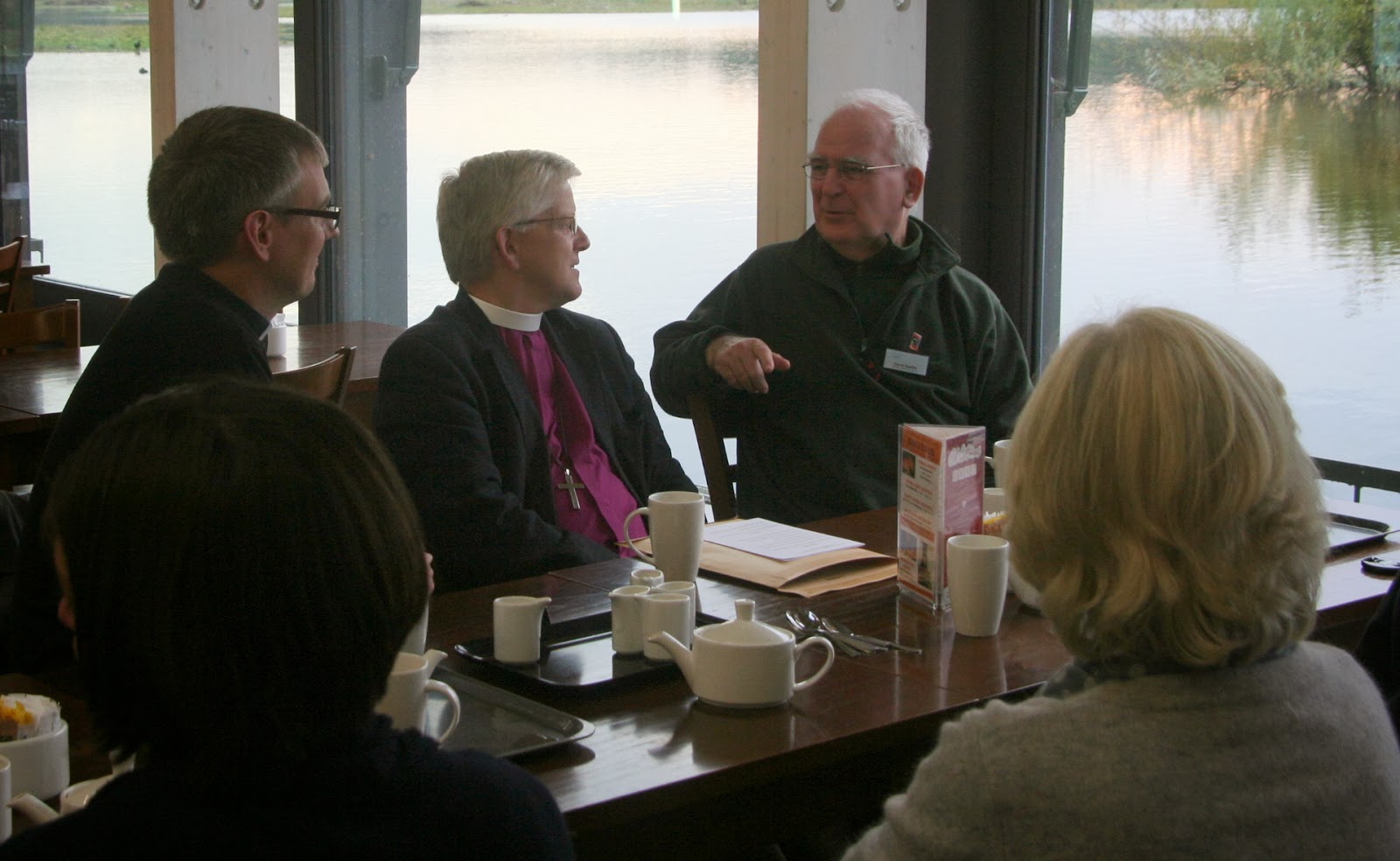
In mid October I was invited by the Blackburn Diocesan Rural and Environmental Officer, Rev Chris Halliwell to join the new Bishop of Blackburn when he visited the Brockholes reserve of the Lancashire Wildlife Trust. It was also great to have Professor John Rodwell with us. John is an ordained priest in the Anglican communion as well as being a professor of plant ecology at Lancaster University. Bishop Julian was there as part of his prayer pilgrimage round his new diocese, and wanted to include the environment on that pilgrimage. After a short prayer walk, we enjoyed the hospitality of the staff at the reserve with a cup of tea in the restaurant.


The third week in November is always the North West Birdwatching Festival. Held at Martin Mere, A Rocha have been attending since the beginning. We have a stand there on both the Saturday and Sunday. We were also invited to hold a Christian Worship service on the Sunday. The Saturday was quite busy and we had several people signing the petition to save the Atiwa Forest. It was so busy I missed seeing a very obliging tawny owl roosting less than 200 metres away. After the Festival on Saturday I went to the A Rocha group at Sandbach where Ruth Valerio had been speaking. The meeting was well attended and it was good to see several long standing supporters . It was a busy weekend for Ruth as she was the speaker at our Sunday service as well. I had gone there to collect her. This year our service was a little earlier than previous, which meant some of our regulars were unable to attend. The  musicians leading that morning were the young people from Christ Church, Southport and Ruth spoke on " Birds and Bread". One of our visitors was Dominic Cousins who was giving a talk on mammals both Saturday and Sunday. A few of us shared some time with him over coffee in the restaurant after the service. Throughout the day we continued to engage with folk as they enquired about the birding trips to Portugal. We also had several more folks signing the Atiwa Forest petition. The weekend was a great time of meeting supporters and gaining new ones.


Sunday, December 29, 2013

North and South part Two

North in this post means the north of England. Each year I receive an invitation from the A Rocha group in Sandbach, Cheshire to lead a bat walk. This is part of their community engagement activities and takes place in Brereton Heath Country Park. This year it was held a little earlier in the year than previous so we did have a slightly longer time before it became dark enough. We did notice some late flying dragonflies, but it was not light enough for good identification. We did a circular walk of the lake and saw and heard both soprano and common pipistrelle. Our bat detectors also enabled us to hear at least one noctule. Once we arrived at the spot in the photograph below we were treated to some excellent views of Daubenton's hunting over the water. Seeing the wildlife and making new friends made this annual event worthwhile.


In August, after missing the Rutland Bird Fair due to ill health, I returned to Southall to help with the second play-scheme. Called Dragon Detectives it takes place on Elsdale II, the largest electric wide-beam barge operating on UK waterways. She can take a full class of pupils for education purposes. We use it in partnership with Groundwork. Cruising up and down the Grand Union canal, we learned about dragonflies and damselflies. Each day involved games and crafts as well as a few songs. We made some bricks and created an early form of animation. Notable sightings were common terns, Banded Demoiselles, several hawkers and darters and the raucous ring-necked parakeet. The excitement for me was noting some frogbit.


Saturday, December 28, 2013

North and South part one

It didn't take me long to head back north. At the end of June, A Rocha were asked to help at an event in Glasgow. A Rocha has been working with Clay Community Church in Possil who have been focusing on community engagement and education at the Clay Pits site. I went along to assist with bug hunting safaris and flower walks. These proved very popular with the local people, who hadn't realised what was on their doorstep. We caught some spiders, butterflies and the occasional damselfly. On one of our walks we disturbed a browsing roe deer. I hope to help with something similar next year. The advantage of having a senior citizens rail card means I can often travel to Glasgow and return for £13.00


In July, I travelled to Southall to help with the first of two week long summer play schemes on Minet Country Park. We had a combination of exploring the park and also indoor craft sessions. A little rain failed to dampen the children's enthusiasm. We had a good pond dipping session finding tadpoles, damselfly nymphs, water beetles, a ramshorn snail, a stickleback, some water mites and three water scorpions. One day we had set some small mammal traps earlier in the morning but didn't catch anything. We did find various samples of poo but only I examined them closely. On our return to the Lodge we made models of different mammals. There were bats, hedgehogs, squirrels and for some reason an elephant, even though we never saw one on Minet.


One day after the session with the children I completed a butterfly survey. I recorded commas, gatekeepers, small whites, large whites, common blues, loads of meadow browns and some six spot burnets. I did get somewhat distracted watching an emperor dragonfly being harassed by two broad bodied chasers. 


It was a very enjoyable week for me and also the kids ( so they said). I returned home looking forward to my next visit later in August


Thursday, December 26, 2013

A few months in a nutshell

I have arrived at December and noted that my last blog was in March. I have not been idle but been doing all sorts of things. In A Rocha UK we have been having a time of reflection and consolidation of our mission.
In April I started a new area of work with the education department of the rspb. This has been at a location Cobble Hey Farm just north of Preston. Children come in order to explore food and farming in a number of ways. Noting the route from farm to fork and how the countryside has changed. They also discover how the farmer manages the habitats in partnership with the RSPB. This is a wetland bird hotspot.
  http://www.cobblehey.co.uk/page.asp?Page=71

     Photo courtesy of RSPB    Poppy Poppy
This coincided with that very cold March which had slowed everything down. We noticed plants were late flowering and migrants later in arriving at their nesting grounds.
In May I took a trip north to visit some friends in Scotland. My first point of call was near Aberfoyle where I surveyed a field used by Glendrick Roost Animal Welfare Centre. A few of us on the ARUK holiday last year has promised to pray they would get the land. When I was asked to help on a survey I couldn't refuse. I do confess I enjoy surveys anyway. The highlight happened as I was trying to identify a plant at the river edge. I heard a splash upstream, and when I looked, there was an otter playing in the river less than 200 metres away. I almost stopped breathing. The other thing that has stayed in my memory was the sight and bouquet of the bluebells.. breathtaking!


The next few days were spent at Kincraig at the northern end of Loch Insh. Here I mainly rested and saw my first game of shinty. This was at the home of the most successful sporting team in the world, Kingussie Camanachd. In the years from1996 to 2004 they only lost two games. These were against their near neighbours and arch rivals Newtonmore. It seems to be a game with few rules. A bit like ice hockey on grass, with the physicality but without excess padding.
                   

Further north to my friends in Spinningdale, near Bonar Bridge, Sutherland. Jim has been slowly building his own eco-house. I had gone to try to see two special flowers, single flowered wintergreen and twinflower. Both these usually flower in late May early June in a nearby wood. Sadly they copied all the other flora this year and were not yet in bloom. I did however see chickweed wintergreen, another life tick for my botany list. There is always something special to see in this area. Ospreys, crested tits, dolphins, red squirrels, Slavonian Grebes, divers, ptarmigans, pine martens and much more, so I couldn't be too disappointed.

  
My trips to the north of Scotland are always a delight. This is not only for the wonderful wildlife but also  so many fantastic friends. I shall be back there soon